 |
||
| Research | Contributions | Matrices | Methods | Library | Photos | Links |
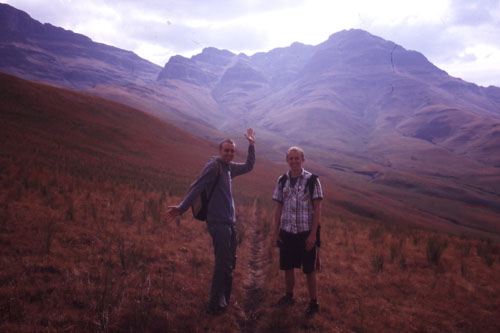 Me (left) in the Drakensburg, South Africa (Photo © E. Lloyd, 2004) Welcome to my web site. I am a University Academic Fellow at the University of Leeds (Leeds, UK). Below is a brief summary of some of my research interests. This site (like so many others) is a work in progress, but I hope one day it will be a useful resource for various palaeontological, phylogenetic and evolutionary methods and data. Diversity curves and sampling biasesModern diversity is so vast that we are yet to aqeduately measure it, yet through the theory of natural selection we know it all stems from a single common ancestor. How we got between these two end points is of central importance to evolutionary biology, but we cannot hope to address this question without the fossil record - our only emprirical record of the diversification of life on Earth. (Molecular biology shows us that crocodiles and birds are each others nearest living relatives, but not that birds are descended from non-avian dinosaurs, a group that underwent a major extinction event at the Cretaceous-Paleogene boundary.) However, the fossil record is incomplete and may give an unreliable record of past diversity. I have been involved in projects examining simple measures of diversity (taxonomic richness) in a variety of groups from habitats beyond the marine shelf (where palaeobiodiversity work has traditionaly been focused) to the open ocean (the largest habitat) and the land (where modern biodiversity is largest). Most show strong correlations with sampling proxies, indicating a potential bias and suggesting sampling-corrected diversity measures may be more reliable than a raw reading of the record. Formal supertrees: towards a phylogenetic hypothesis of fossil tetrapodsPhylogenetic measures of diversity and diversification are becoming increasingly important to palaeontologists, but they require large trees as a starting point. For extant taxa large amounts of sequence data can be compiled to produce such trees, but for extinct taxa we are hampered by a large array of conflicting and incompletey coded morphological characters. Consequently formal and informal supertrees are more commonly marshalled when large phylogenies are required. I have been involved in projects that produce both forms. Although I prefer the transparency and objectivity of formal supertrees there is clearly room for improvement in their construction and I am presently working on a number of techniques to do this. I am also compiling a database (see Matrices) of cladistic analyses as part of a longer term project to produce a formal supertree for fossil tetrapods. Branch lengths and rates of discrete character evolutionPalaeontologists have traditionally dated phylogenetic trees within a parsimony mindset of setting node ages as equal to that of their oldest descendant (thus minimising the number of unsampled lineages). However, this approach leads to numerous problems when translated into a phylogenetic hypothesis - most notably creating a large number of zero-length branches. This is particularly problematic to studies of rates between cladogenetic events as it means the divisor is zero. I have implemented other worker's solutions to this issue as R code (see here) and am presently working on a novel algorithm that returns a probability distribution of ages for each node in a tree of fossil taxa - mimicing the results of a typical molecular clock analysis. I am also interested in measures of rates of evolution in discrete characters and have worked on several techniques, both published and unpublished, on accounting for various potential artefactual biases that may lead to heterogenous rates when true rates are actually constant. Disparity in discrete charactersA popular alternative palaeobiodiversity measure to simple taxonomic richness has been morphological disparity. I have been tangentially involved with projects examining this measure, but feel there is still room for a number of methodological improvements and am working on R code to handle cladistic matrices as an input to produce novel disparity measures. |
||
| Last updated 7th November 2008. | ||

